The questions that drive media art and transhumanist thinking are not new. How far can human intention modify a natural system before the system becomes something else? Where is the boundary between the body and the tool, between the landscape and the design imposed on it? What does it mean to inscribe human meaning into organic matter at scale? These questions feel urgent now because of the speed at which technology is accelerating the answers, but they are in fact ancient. Civilisations have been running the experiment for millennia.
Phnom Kulen, the plateau mountain 50 kilometres northeast of Siem Reap in northern Cambodia, is one of the most ambitious examples in the archaeological record. The Khmer Empire, which built Angkor Wat and the surrounding temple complex across the 9th to 15th centuries CE, began its project of landscape transformation here, on this sandstone plateau, where the rivers that flow to the plain below were carved with thousands of sculpted forms and the entire topography was understood as a sacred machine for converting natural water into consecrated force. What they built is not separate from the mountain. It is the mountain, modified to mean something.
Here are eight reasons it rewards the attention of anyone who thinks seriously about the intersection of human design and the natural world.
1. The Kbal Spean River Carvings Are a River Bed Turned Into a Ritual Interface
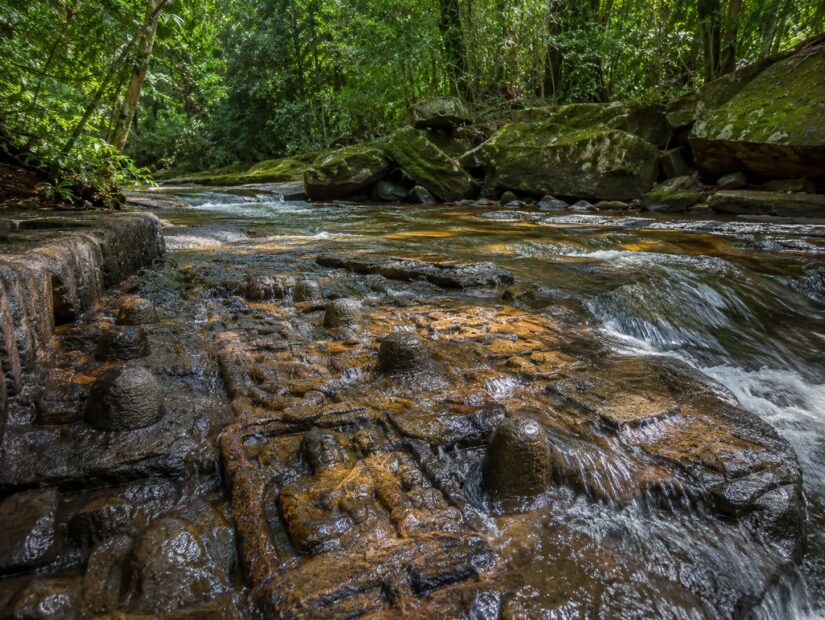
At Kbal Spean, on the northern edge of the Phnom Kulen plateau, the Stung Kbal Spean river runs over a sandstone bed that Khmer sculptors carved with over a thousand lingam, the cylindrical form associated with the deity Shiva, along with reclining Vishnus, nagas, and other iconographic elements cut directly into the living rock of the riverbed. The water flows over these forms continuously, consecrating itself as it passes and carrying that consecration downstream to the fields and communities that depend on irrigation from the river system.
This is not decoration applied to nature. It is an interface built into nature: a system designed to use the river’s own movement as a ritual process, converting kinetic energy into sacred significance at every point of contact between water and carved stone. For media artists and designers interested in interactive systems, in the boundary between a designed object and the environment it occupies, Kbal Spean is a 1,000-year-old precedent that operates with a sophistication that most contemporary installation art does not match in conceptual depth.
2. The Hydraulic Engineering Turned a Plateau Into a Sacred Machine
The Khmer civilisation’s relationship with water engineering has been studied intensively by archaeologists and hydrologists since the late 20th century. The baray, the enormous rectangular reservoirs around Angkor, are the most visible element of a hydraulic system that extended across the entire Angkor region and relied on Phnom Kulen as its source. The rivers flowing from the plateau were the freshwater supply for a city that may have housed a million people at its height in the 12th century.
Managing that supply required an understanding of topography, rainfall, storage capacity, and distribution that is engineering in any functional sense of the word. The Khmer engineers modified the plateau’s natural drainage to direct water where they needed it, built canals and embankments that altered the hydrology of a region hundreds of square kilometres in extent, and maintained this infrastructure across generations with a precision that satellite archaeology is still mapping. The system was not built on the landscape. It was the landscape, redesigned from the source to the delta.
3. The Reclining Buddha Carved From the Living Rock Is Monumental Bioart
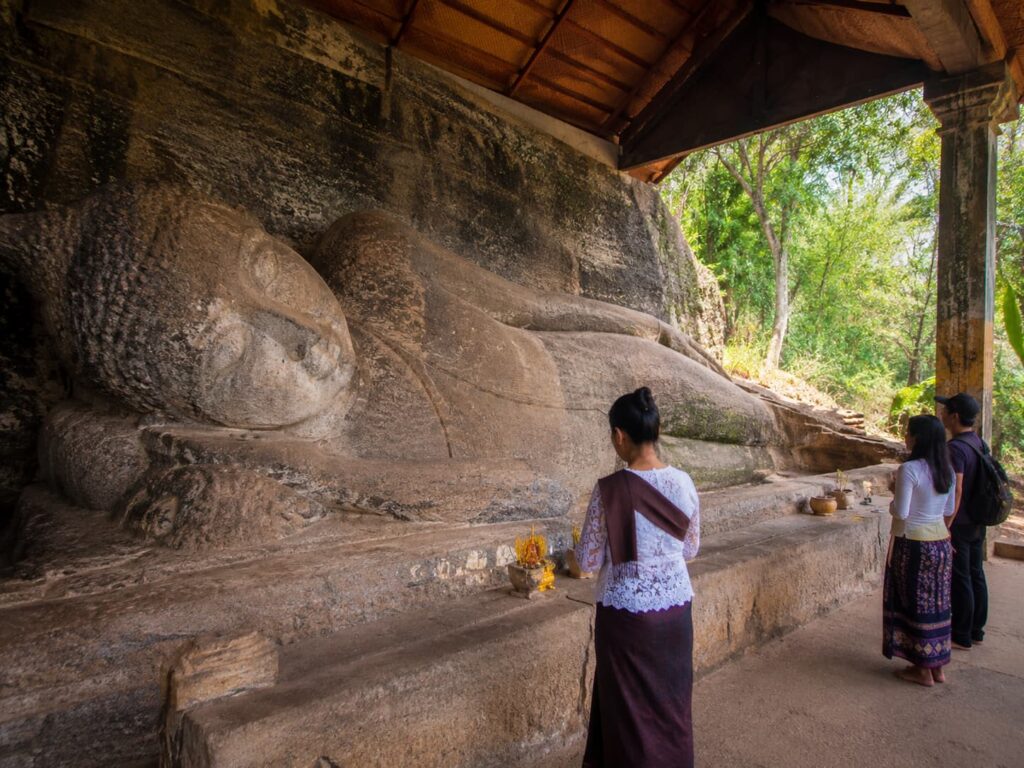
On the summit plateau of Phnom Kulen, a reclining Buddha figure roughly eight metres long has been carved from a single sandstone outcrop. The figure does not sit on the rock. It emerges from it. The surrounding stone was removed to reveal the form already implied in the mass of the outcrop, in the same way that classical sculptors described their process as removing everything that was not the figure inside the block. The Buddha and the mountain are the same material, continuous, with the carving as the interface between geology and intention.
The ethics of bioart as discussed on this blog centre on what it means to use living or organic material as the medium for human expression, and what responsibilities that use generates. The Phnom Kulen Buddha complicates the question productively: the material is geological rather than biological, but the intention is the same. A natural form has been modified to carry human meaning. The modification is irreversible. The resulting object is neither fully natural nor fully constructed. It occupies the same ambiguous category as the cyborg bodies and bio-installations that contemporary artists are still arguing about.
4. The Mountain Itself Was Understood as a Body
In Khmer cosmology, Phnom Kulen was identified with Mount Meru, the sacred mountain at the centre of the Hindu universe, the axis around which the cosmos rotates and from which all rivers of the world descend. This identification was not metaphorical in the way a modern reader might assume. It was literal and operational. The mountain was the axis. The rivers that flowed from it were the sacred rivers of creation. The carvings in the riverbed were acts performed on the body of the cosmos itself.
This cosmological framework produced a relationship between human action and natural landscape that has no precise equivalent in the Western tradition, but that resonates directly with transhumanist thinking about the body as a system that can be modified, extended, and redesigned without losing its identity. The Khmer did not build on top of the mountain. They worked inside it, treating the geological formation as a body to be shaped rather than a surface to be covered. The distinction matters conceptually and it is visible in the archaeology.
5. The Waterfall at Phnom Kulen Is the Physical Mark of the Plateau’s Sacred Boundary
At the northern edge of the Phnom Kulen plateau, the Stung Kbal Spean drops over a sandstone escarpment in a waterfall that marks the boundary between the consecrated upland and the plain below. The point where the sacred water leaves the plateau and enters the ordinary landscape is architecturally framed by the carved riverbed immediately upstream: the last thing the water touches before its descent is the ritual iconography that defines its character.
This is design thinking about threshold conditions: the boundary between two states, the moment of transition, the interface between the sacred and the ordinary. Media artists work with exactly this kind of threshold consistently, whether in interactive installations that change state when a viewer crosses a line, or in new media works that frame the transition between digital and physical space as the content of the piece. Phnom Kulen built that threshold into the topography of a mountain and has been running the same transition continuously for over a thousand years.
6. Guided Tours Navigate the Plateau’s Multiple Sites and Their Connections
Phnom Kulen is a large plateau, about 40 kilometres long and covered in dense forest broken by temples, carved rivers, waterfalls, and village settlements. The main sites, the Kbal Spean carvings, the reclining Buddha, the 9th-century brick temples, and the waterfall, are spread across the plateau in ways that are not efficiently navigable without local knowledge of the roads, the footpaths, and the seasonal conditions that determine which sites are accessible on a given day.
Operators like Phnom Kulen Tours offer guided experiences that connect the plateau’s key sites within a structured itinerary, with guides who understand both the logistics and the historical and cosmological context that makes each site legible as part of a larger design intention. For visitors whose interest in Phnom Kulen extends to the conceptual framework behind the Khmer landscape project, rather than just the physical sites in isolation, this kind of contextual guidance is the difference between seeing impressive ruins and understanding an argument.
7. The Angkor Connection Makes Phnom Kulen the Origin Point of Everything That Followed
Phnom Kulen was where Jayavarman II declared himself a devaraja, a god-king, in 802 CE, inaugurating the Khmer Empire and establishing the cosmological and political framework that would produce Angkor Wat three centuries later. The mountain was chosen as the site for this declaration because of its identification with Mount Meru: the king declaring himself a god-king at the axis of the universe was performing a cosmological claim, not just a political one.
Everything that followed at Angkor, the temple mountains, the hydraulic systems, the cosmological city plan that oriented every major structure toward the cardinal directions and the rising and setting sun, was an extension of the conceptual framework established on Phnom Kulen. Understanding Angkor without understanding Phnom Kulen is like understanding a body of work without the manifesto that preceded it. For designers and artists who think about the relationship between conceptual foundation and executed work, Phnom Kulen is where the Khmer argument was first stated. Angkor is where it was developed at scale across 400 years.
8. The Active Buddhist Community on the Plateau Keeps the Design System Alive
Phnom Kulen is not an archaeological site in the Western sense of a preserved ruin separated from contemporary use. The plateau is a living pilgrimage destination for Cambodian Buddhists, who visit in large numbers on weekends and religious holidays to bathe in the consecrated water at the base of the waterfall, make offerings at the reclining Buddha, and walk the paths between the old temples. The sacred use of the landscape that the Khmer engineers designed for continues, in adapted form, in the same physical spaces.
This continuity between ancient design intention and contemporary use is unusual in the global heritage landscape. Most archaeological sites of comparable age are preserved precisely by being separated from the living communities that might modify or damage them. Phnom Kulen’s continued function as a sacred space means that the design system is still operating, still being interpreted, still generating the social and ritual behaviours that the original landscape modification was intended to produce. The cyborg aesthetic argument that technology and the body are not separable but continuous applies equally to this landscape and its community: the mountain and its pilgrims are a system that has been co-evolving for over a thousand years, and neither makes full sense without the other.
A Final Thought
The most interesting precedents for the questions that media art and transhumanism are asking now are often not in the recent history of technology. They are in the places where human civilisations decided, with the tools available to them, to redesign their environment at the scale of the landscape itself: to carve their cosmology into the riverbed, to turn the mountain into a machine, to make the boundary between the natural and the designed so thoroughly ambiguous that the distinction stops being useful.
Phnom Kulen is one of those places. The Khmer did not build on the mountain. They modified it from the inside, treating the geological formation as a medium in the same way that a sculptor treats stone or a media artist treats code: as a material that resists, that has its own properties and constraints, and that produces meaning precisely through the negotiation between what it is and what you are trying to make it become.
That negotiation is still visible on the plateau. It is worth going to see.